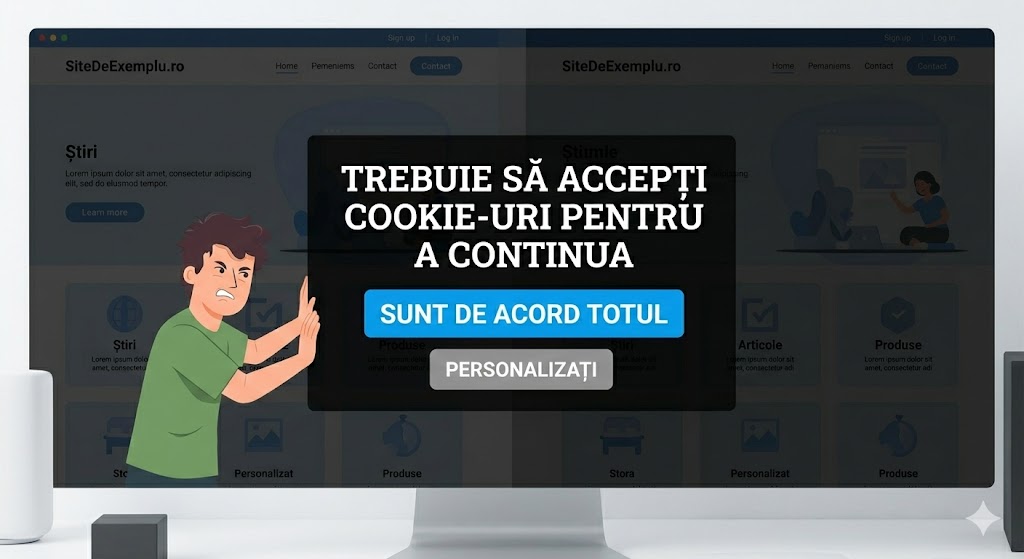
For many website owners in Romania, the “cookie wall” (that dark overlay blocking your content until a user clicks “Accept”) has become a go-to solution for tracking. However, recent enforcement actions by the ANSPDCP (The National Supervisory Authority for Personal Data Processing) and updated European guidelines have made it clear: these practices are high-risk and often can be considered as non-compliant and even illegal.
The “Freely given” consent trap
Under GDPR Article 4(11), consent is only valid if it is “freely given, specific, informed, and unambiguous”. When you block your content with an overlay, you are effectively forcing the user to “pay” with their data to gain access.
The EUROPEAN DATA PROTECTION BOARD (EDPB) explicitly states that if a user has no real choice but to click “Accept” to see your site, that consent is legally void. If the consent is void, every tracking pixel and cookie you fire (from Google Analytics to Facebook Pixel) is a direct violation of the law.
2026 Updates: The Digital Omnibus proposal and new realities
As of early 2026, the regulatory landscape has shifted even further toward user protection:
- The Digital Omnibus proposal: The EU Commission is moving to consolidate cookie rules directly into the GDPR. This includes a mandatory “Single-Click Refusal” standard, ensuring users can reject all cookies with the same ease they accept them.
- The 6-month cooling period: Under 2026 proposals, if a visitor refuses your cookies, you cannot ask them again for at least six months.
- ANSPDCP enforcement in Romania: In late 2025 and early 2026, the Romanian authority issued multiple fines (ranging from 15,000 lei to 30,000 lei) to companies like LENJERIA MAGICĂ SRL and THERE’S AN AI FOR THAT S.R.L for installing non-essential cookies without explicit, easy-to-provide consent.
The Business case: Why transparency beats “Dark patterns”
Many businesses fear that adding a “Reject” button will destroy their marketing data. However, 2026 studies show that the “grudging accept” is a dying metric.
- Trust as a conversion factor: A 2025 study by Usercentrics found that 44% of consumers cite transparency in data use as their primary trust factor when choosing a brand.
- Data quality over quantity: Grudgingly obtained data is often low-quality. 2026 marketing trends favor “Zero-Party Data” (data users proactively share), which has a 15% to 20% higher conversion rate than data harvested through deceptive cookie walls.
- SEO and user experience: Google continues to penalize intrusive interstitials. A cookie wall that blocks content is viewed as a barrier to the user, potentially hurting your Core Web Vitals and search rankings.
Studies and data:
1. Usercentrics: The State of Digital Trust 2025
This study, based on a survey of 10,000 consumers across the EU and USA, confirms that privacy is now a “first brand impression”.
- Key Finding: 44% of consumers state that being transparent about how their data is used is the single most important factor in earning their trust.
- Official Link: Usercentrics: The State of Digital Trust in 2025 Report
- Report: The State of Digital Trust in 2025
2. Zero-Party Data: Conversion and Performance
Zero-party data (ZPD) is information that a user intentionally shares with a brand, such as preferences or shopping intentions.
- Key Finding: Aligning offers to declared intent (ZPD) reduces friction at the point of purchase. Marketing efforts using this direct data can boost revenue by 5% to 15% and improve marketing ROI by 10% to 30%.
- Data Quality: 77% of marketers have shifted focus from data quantity to quality, as privacy-respecting strategies lead to higher long-term marketing resilience.
- Official Link: Zero-Party Data: The Future of Personalized Marketing
3. Google SEO: Intrusive Interstitials and Core Web Vitals
Google has officially penalized intrusive overlays since 2017, but the standards for 2026 are even stricter regarding content accessibility and performance.
- Key Finding: Cookie walls that block access to content are considered “intrusive interstitials” and can negatively impact rankings. Poorly implemented banners also degrade Core Web Vitals (specifically LCP and INP), which are direct ranking signals in 2026.
- The “INP” Impact: As of 2025, Interaction to Next Paint (INP) measures how quickly a site responds to clicks. A “heavy” cookie wall that lags when a user tries to “Accept” or “Reject” will directly lower your site’s performance score.
- Official Link: Google Search Central: Interstitials and Dialogs
- Technical Reference: Do Cookie Banners Affect Your Core Web Vitals?
2026 Best practices for Romanian e-commerce
To balance GDPR compliance with conversion goals, follow these 2026 industry standards:
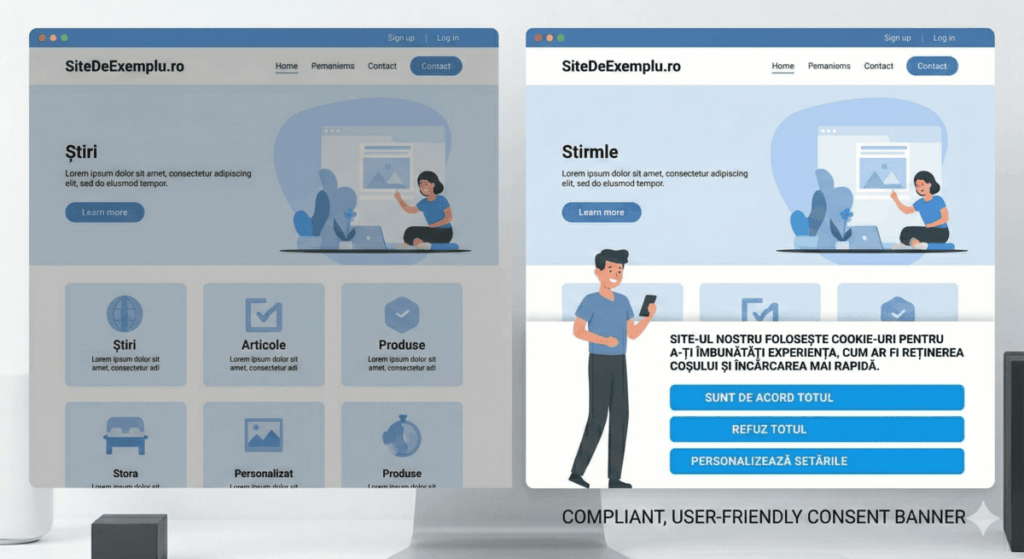
- Add a Reject button: It must be on the first layer of your banner. Rejection must be just as easy as acceptance (identical button size, color saturation, and visual weight).
- Remove the overlay: Allow users to navigate your site even if they ignore the banner. No non-essential cookies should fire until they click “Accept.”
- Benefit-focused copy: Instead of “We use cookies,” try “Helps pages load faster and remembers your shopping cart.” This increases engagement by 15% to 20%.
- Implement Google Consent Mode v2: For sites using Google Ads, this is essential. It allows for “conversion modeling” even when users click “Reject,” recovering up to 65% of lost data legally.
- Accessibility (WCAG 2.2): As of June 2025, the EUROPEAN ACCESSIBILITY ACT mandates that cookie banners must be navigable via keyboard and screen readers.
Official resources and legal sources
To ensure your business remains compliant, refer to these official documents:
- EDPB Cookie Banner Taskforce Report: The definitive technical guide for banner design.
- ANSPDCP News: Track recent fines issued under Law no. 506/2004 in Romania.
- The Orange Romania Case: A landmark ruling by the Court of Justice of the EUROPEAN UNION (Case C-61/19) confirming that “bundled” consent is illegal.
Conclusion
Compliance is your “first brand impression” in 2026. A clean, non-intrusive banner that respects a user’s right to say “No” without blocking their path is the strongest signal of a professional, trustworthy business.
Need help?
I am an eBusiness consultant specializing in digital strategies. Feel free to contact me if you need guidance with your eCommerce and/or SEO projects. If you want to check your current cookie compliance or need a custom solution that follows the 2026 standards, I can help you get it right.
Be safe, Be compliant!