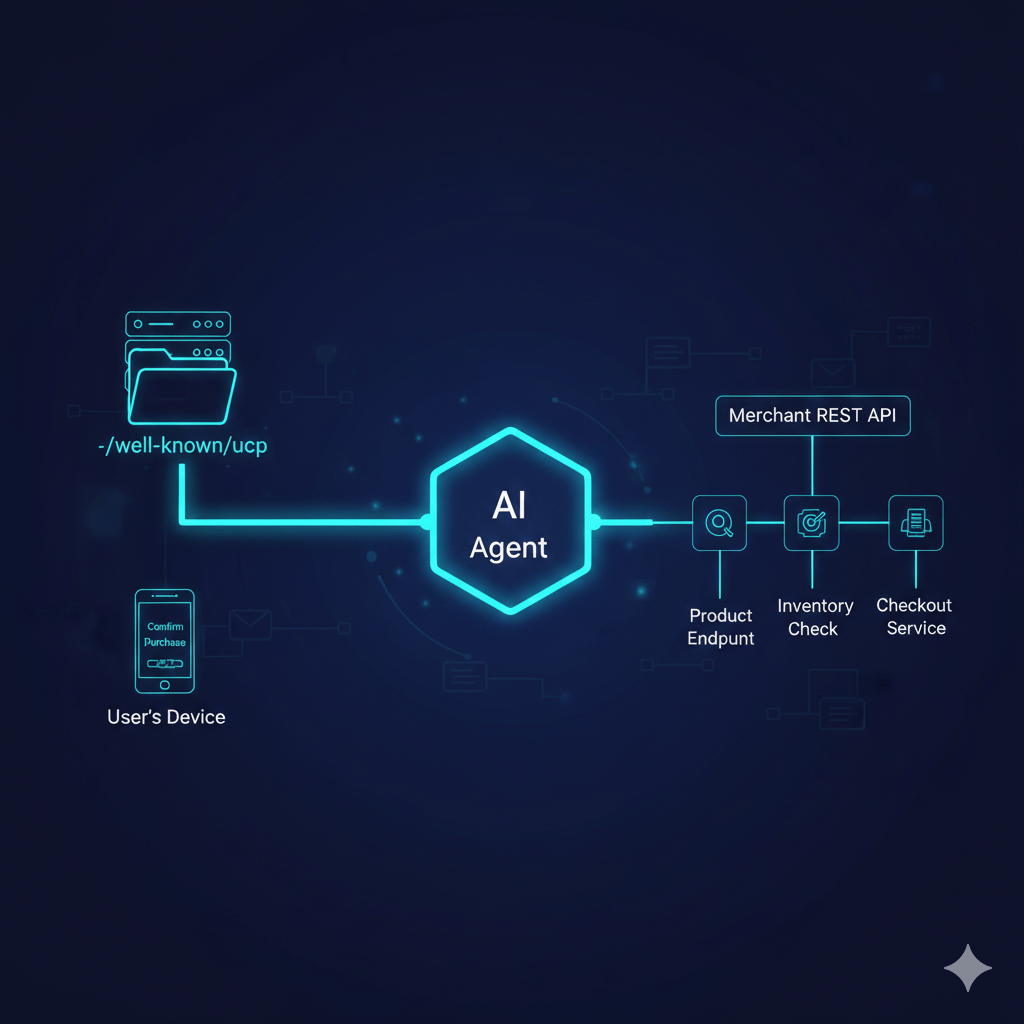
In February I published my technical guide to the Universal Commerce Protocol, when the standard was barely a month old. Eight months later, UCP has shipped two big spec releases and gained serious new backers. However, live checkout is still rolling out slowly. So here is my practitioner update: what changed, who really adopted it, and what I would do now.
What changed in the Universal Commerce Protocol since February
The biggest change is maturity. Back in February, most of us were reading launch posts and guessing at the details. Now the project publishes dated releases, governance notes and working group minutes on ucp.dev and GitHub.
Release v2026-04-08: carts, catalogs and identity
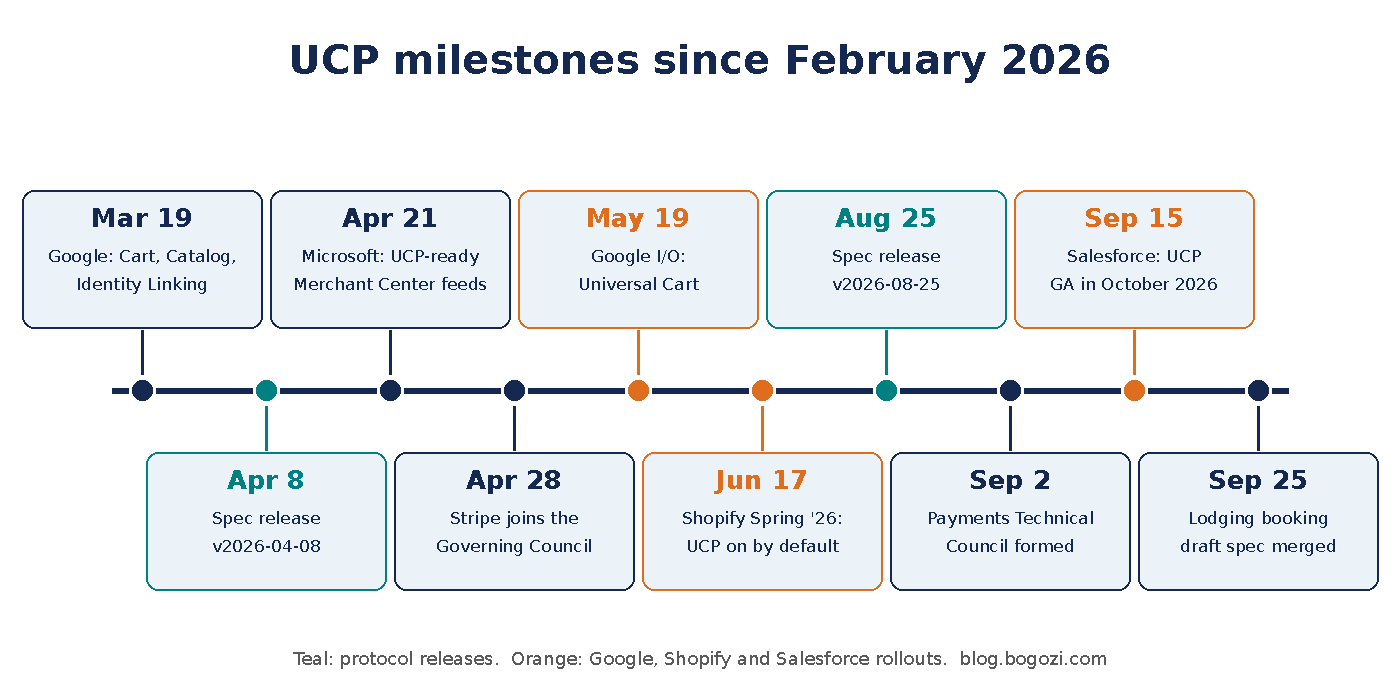
The April release added the pieces I missed most in January. First, a Cart capability lets an agent build a basket with several items from one store. Second, Catalog search and lookup let agents pull live variants, stock and prices. Google described the same additions in its March 19 post, together with Identity Linking.
Identity Linking matters more than it sounds. It builds on OAuth 2.0, so a logged-in shopper keeps member prices or free shipping inside an agent. The release also added request and response signing, clearer error handling and a stricter order schema.
Release v2026-08-25: payments, policies and new verticals
The August release is the heavy one. On the payment side, it adds 3D Secure (3DS2) flows, payment schedules for deposits and installments, and split payments. It also adds a loyalty extension, so rewards no longer hide inside discount workarounds.
For SEOs, two additions stand out. A new policies snapshot carries return, refund and warranty terms through cart, checkout and order. In addition, location search, opening hours and fractional quantities prepare the ground for grocery and local pickup. Be aware that this release also restructured the fulfillment schema, which breaks older integrations.
My February manifest example is now outdated
If you copied the JSON snippet from my February guide, please revisit it. The current spec wraps the profile in a ucp object with a date-based version, such as 2026-08-25. Services and payment handlers are required registries, even when empty. Signing keys now sit in a top-level keys array, and the spec names EC and Ed25519 keys instead of RSA.
{
  "ucp": {
    "version": "2026-08-25",
    "services": { "dev.ucp.shopping": [ ... ] },
    "capabilities": { "dev.ucp.shopping.checkout": [ ... ] },
    "payment_handlers": { ... }
  },
  "keys": [
    { "kty": "EC", "crv": "P-256", "kid": "key-1", "x": "...", "y": "..." }
  ]
}
The Merchant Center side changed as well. Google now documents native_commerce(checkout_eligibility) as the eligibility flag, and it defaults to false. Also, if your feed ID differs from the ID your checkout API expects, you map it with merchant_item_id.
Who adopted UCP so far, with dates
Endorsements are easy, while live checkout is hard. Therefore, I only list moves that companies announced on their own sites or on ucp.dev.
| Date (2026) | Who | What they announced |
|---|---|---|
| Mar 19 | Cart, Catalog and Identity Linking; simpler Merchant Center onboarding; Commerce Inc, Salesforce and Stripe to implement UCP | |
| Apr 21 | Microsoft | UCP-ready feeds generally available in Microsoft Merchant Center (US) |
| Apr 24 and 28 | Amazon, Meta, Microsoft, Stripe, Salesforce | New seats on the UCP Tech Council; Stripe also joined the Governing Council |
| May 19 and 20 | Universal Cart, select checkout features “soon” with Nike, Sephora, Target, Walmart and others, plus plans for Canada, Australia, the UK, YouTube, hotels and food delivery | |
| Jun 17 | Shopify | Spring ’26 Edition: merchants are UCP-enabled by default, and AI channels are managed in Agentic Storefronts |
| Jul 16 to Sep 2 | Food, Lodging and Payments councils | DoorDash, Uber Eats, Toast, Booking.com, Expedia, Marriott, Hilton, PayPal, Adyen and others joined technical councils |
| Sep 15 | Salesforce | Commerce Cloud integration with UCP generally available in October 2026 |
| Sep 25 | Lodging Tech Council | Draft hotel booking capability merged into the spec |
How I read the adoption news
I have two caveats here. A council seat is not a live checkout button, so I treat governance news as a direction signal. Timelines also slip. Google’s May posts promised Canada and Australia in the coming months, yet the Merchant Center help page now says those markets follow next year.
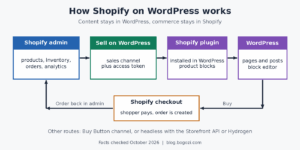
For Shopify stores the picture is simpler. Shopify says its merchants are UCP-enabled by default, with all AI channels in one admin view. If you run a Shopify store next to a WordPress site, my notes on combining Shopify with WordPress explain how that setup works.
What SEOs and store owners should do now
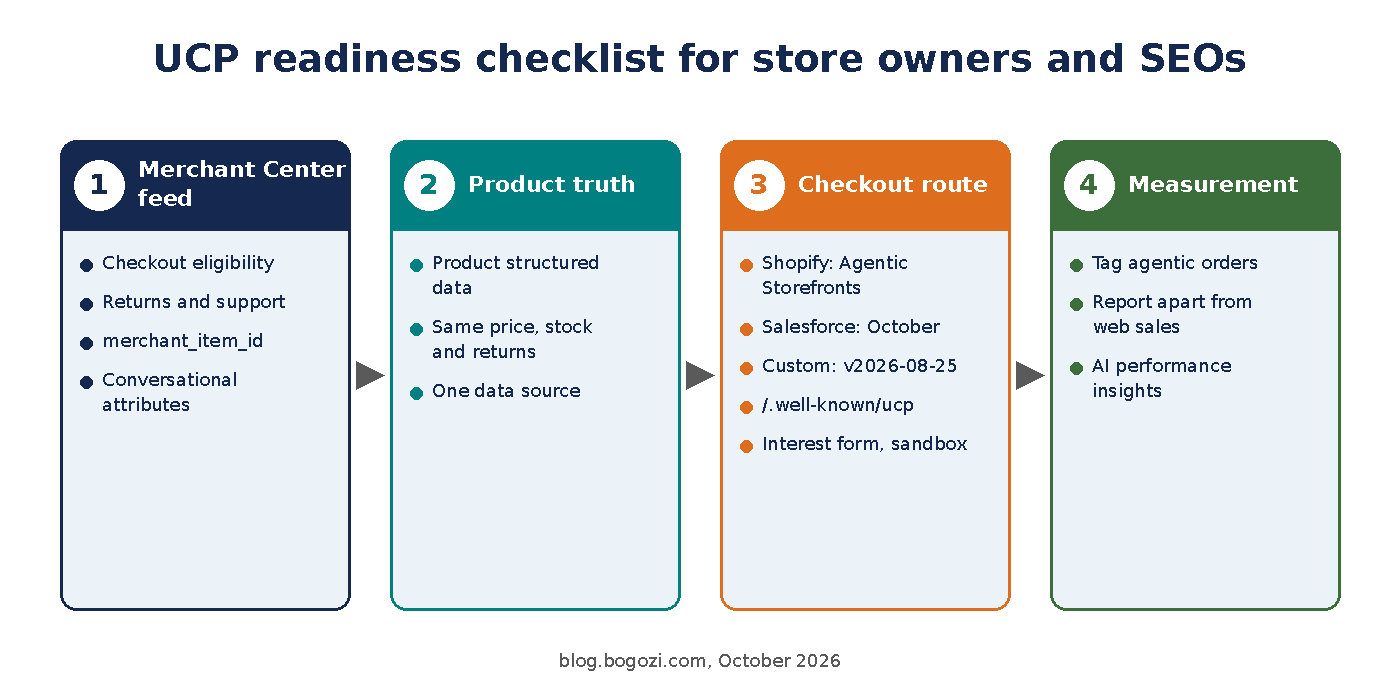
Here is the checklist I now use with clients. None of it requires an invitation from Google, and most of it also helps classic Shopping results.
1. Clean up your Merchant Center feed
Start with the data Google already asks for. Add the checkout eligibility flag to products you can really ship, and leave restricted items out. Next, set return policies and customer support details, because Google treats both as merchant of record requirements. Finally, fill the conversational attributes that Google opened to retailers globally in May.
2. Keep product truth consistent
Agents compare your feed, your product page and your checkout response. Consequently, any mismatch in price, stock or return terms becomes a trust problem. I keep Product structured data, the feed and the checkout API on one data source. The new policies snapshot makes this even more important, since return terms now travel with the order.
3. Decide your checkout route
Your platform decides most of the work. Shopify merchants should review Agentic Storefronts, while Salesforce Commerce Cloud merchants can expect the integration this October. For WooCommerce or custom stacks, build against v2026-08-25 and publish your profile at /.well-known/ucp. After that, fill in Google’s interest form to get sandbox access in Merchant Center.
4. Measure agentic orders separately
Agentic orders skip your product pages, so I tag them by channel and report them apart from web sales. The spec now carries an attribution field for referral context, which helps. Google also announced AI performance insights in Merchant Center to compare your share of voice on AI surfaces. If your funnel tracking is weak today, start with my cart abandonment setup in Google Analytics.
My take after eight months
This agentic checkout standard is no longer a Google side project. With Shopify, Stripe, Microsoft and Salesforce involved, it looks like shared infrastructure. Still, real checkout volume outside the US has not arrived yet.
So my advice is calm but firm. Fix your feed and policy data now, since that work pays off either way. Meanwhile, keep the February 2026 Google update in mind, because AI Mode keeps reshaping how products surface. I will keep testing UCP on client stores and share what I measure.
Sources
- Announcements, UCP project, ucp.dev, latest entry Sep 25, 2026
- Release v2026-04-08, UCP on GitHub, Apr 8, 2026
- Release v2026-08-25, UCP on GitHub, Aug 25, 2026
- Specification overview (version 2026-08-25), ucp.dev, accessed Oct 9, 2026
- AI shopping gets simpler with Universal Commerce Protocol updates, Google, Mar 19, 2026
- Introducing the Universal Cart and more ways to help you shop, Google, May 19, 2026
- How we’re helping retailers thrive with new Universal Commerce Protocol features and AI tools on Google, Google, May 20, 2026
- How to onboard to the UCP integration hub in Merchant Center, Google Merchant Center Help, accessed Oct 9, 2026
- Prepare your Merchant Center account, Google for Developers, updated Oct 2, 2026
- Win across all three eras of the web, Microsoft Advertising, Apr 21, 2026
- Selling everything, everywhere, all at once: The Spring ’26 Edition, Shopify, Jun 17, 2026
- Salesforce and Google Cloud Unify Infrastructure and Agents for One Connected AI Stack, Salesforce, Sep 15, 2026