
Welcome to my state of AI October 2026 report. It is the first edition of a monthly AI roundup for small business owners, SEOs and shop managers. For AI in October 2026, that means search, shopping agents, new models and EU rules. As always, I skip the noise and list the primary sources at the end.
Why I start with a video about slop
Recently I watched the long Aperture livestream “We’re Not Ready for What’s Coming Next”. Its best idea is simple. Cheap AI content breaks the link between effort and meaning, so people stop trusting what they read online.
In the narrator’s words, “The internet does not need more content. It needs more creators.” I agree with that, because my clients win with real expertise, not volume.
However, the video is opinion, and several of its numbers do not hold up. So I checked them against primary sources first.
What the video got right and wrong
Right:
- The World Economic Forum does expect big disruption: 92 million jobs displaced and 170 million created by 2030.
- The Pentagon did label Anthropic a supply chain risk. In fact, an appeals court upheld that label on 25 September 2026.
- AI channels really grow fast on YouTube. The Guardian counted 9 of the 100 fastest growing channels in July 2025.
Wrong:
- Facebook’s 2012 emotion experiment covered 689,003 users, not 70,000.
- AlphaProof did not win IMO gold in 2025. Instead, Gemini Deep Think reached the gold medal standard, while AlphaProof reached silver standard in 2024.
- Amazon’s job cuts did not take AWS down. The outage hit on 20 October 2025, eight days before the 14,000 cuts, and a DNS race condition caused it.
Search: Google now asks for proof of human care
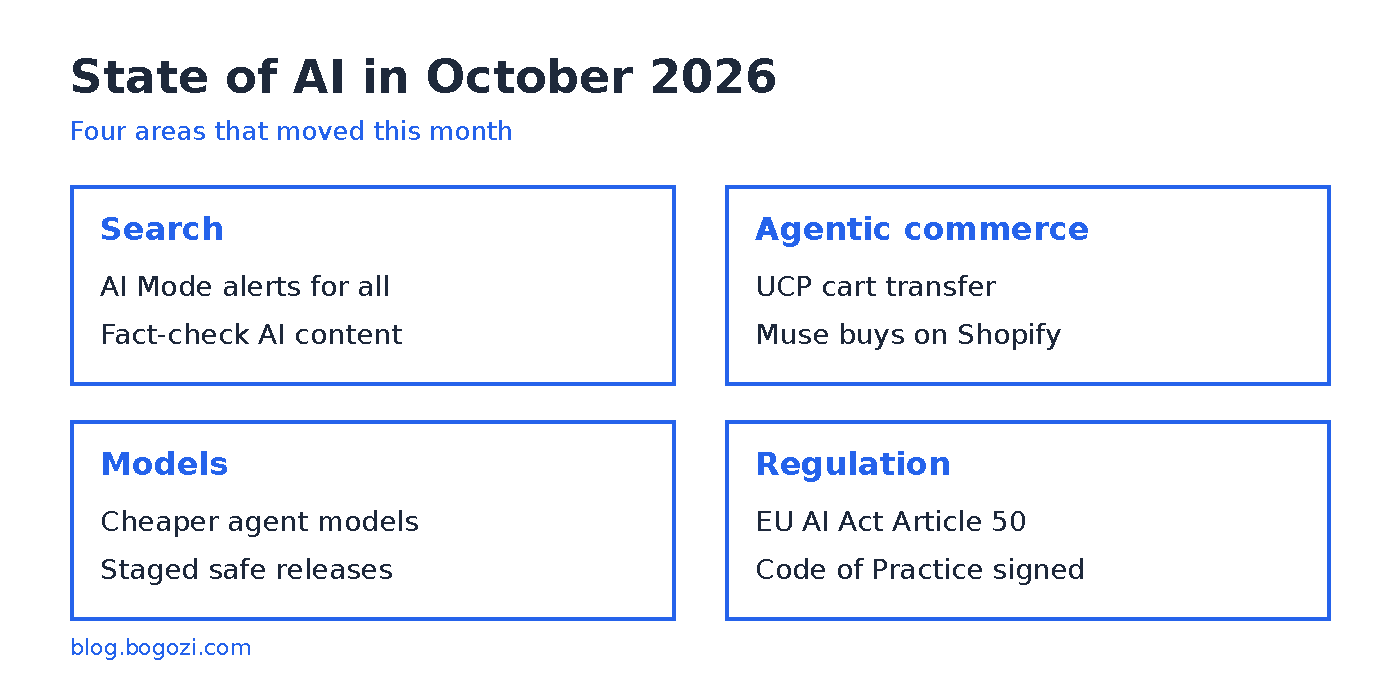
On 28 September, AI Mode “info monitoring” opened to all users globally. You tell AI Mode what to watch, for example restocks, price drops or new local openings. Then the Google app alerts you. It draws on the web, forums and a Shopping Graph of more than 60 billion products.
For shops, this turns feed accuracy into a re-engagement channel. If your Merchant Center price or stock is stale, the alert goes to a competitor instead.
Meanwhile, on 1 October Google updated its guidance on generative AI content. Site owners should fact-check AI output by hand before it goes live. According to reporting, that review also covers titles, meta descriptions, structured data and alt text.
Google’s helpful content page also names AI headshots, invented names and false credentials as deception. It calls them “a signal of a low-quality page”.
Finally, the September 2026 spam update ran from 24 September to 8 October. There was no core update in this window. If traffic moved, check Search Console against those dates first. I covered the bigger picture in my piece on whether SEO is dead, and the short answer still holds.
Agentic commerce stops being a demo
On 16 September Google shipped its holiday shopping updates. AI performance insights in Merchant Center became generally available in Australia, Canada, India, New Zealand and the US. They show your share of voice in AI Mode and AI Overviews.
The UCP integration hub also added cart transfer to the merchant site, plus checkout flow testing. Google says UCP already enables direct checkout for “hundreds of thousands of brands”. In its own test, lululemon’s conversational attributes appeared in 50% of relevant AI Mode recommendations. If UCP is new to you, start with my technical guide to the Universal Commerce Protocol.
On the same day, OpenAI added a ChatGPT Ads app for US Shopify merchants and a HubSpot integration. It also started testing Sponsored Agents, labelled brand agents that open after an ad click. The Shopify app reaches international ChatGPT Ads markets from 23 September.
Then Meta made it consumer scale. Its Muse agent can browse, fill forms and check out with Stripe Link and Shop Pay across Shopify stores. Amazon, by contrast, blocked Muse.
So the platforms are splitting into open and closed camps, which matters if you run Shopify on WordPress. Note that most of this launches in the US first, while my EU clients wait.
Models: cheaper, more agentic, released in stages
Prices kept falling this month. OpenAI launched GPT-6.1 Sol at DevDay on 29 September, at $2 input and $10 output per million tokens. It also introduced an Agents API with computer use. A day earlier, OpenAI cancelled the October release of GPT-6.1 Astra over alignment test regressions.
Anthropic released Claude Opus 5.5 on 22 September at $4 and $20 per million tokens. Its outputs carry a watermark for EU AI Act compliance. Google followed with Gemini 4 Argon on 30 September, first limited to trusted cyber defenders. Likewise, xAI shipped Grok 4.7 at $2 and $6.
Assistants changed too. Apple’s new Siri AI, built with Google’s Gemini models, arrived with iOS 27 on 14 September. Siri AI is not available in the EU at first, though. Microsoft also unified Copilot into one app with Code and Autopilot, a persistent agent.
In short, AI in October 2026 means cheaper agents, gated by staged safety releases.
Regulation in the EU and the US
For my EU readers, this section matters most. Article 50 transparency duties of the EU AI Act have applied since 2 August 2026. About 190 organisations signed the Code of Practice on Transparency of AI-generated Content.
Section 1 covers providers that mark outputs, such as Anthropic, Google, Meta, Microsoft, Mistral and OpenAI. Section 2 covers deployers that label deepfakes and AI text on matters of public interest. Romanian signers include the National Bank of Romania, Harghita County Council and Minio Studio SRL.
Across the Atlantic, a US appeals court sided 2 to 1 with the Pentagon on 25 September. It upheld the supply chain risk label on Anthropic. That contradicts an August district court ruling. It changes little for a small shop, but it shows how political AI vendors have become.
A hype reality check
The video calls AI a bubble, and some numbers do support caution. MIT NANDA’s 2025 report found that 95% of organisations got zero measurable return from generative AI. Critics question its sample, though. Bain estimates AI needs $2 trillion in annual revenue by 2030 and sees an $800 billion shortfall.
Still, capability is real. On 6 October OpenAI shared 722 maths papers from an unreleased model, many with Lean formal proofs. Mathematicians are split on it. My view sits in between: the tools work, but the business case depends on your process, not the model.
My state of AI October 2026 checklist for small businesses
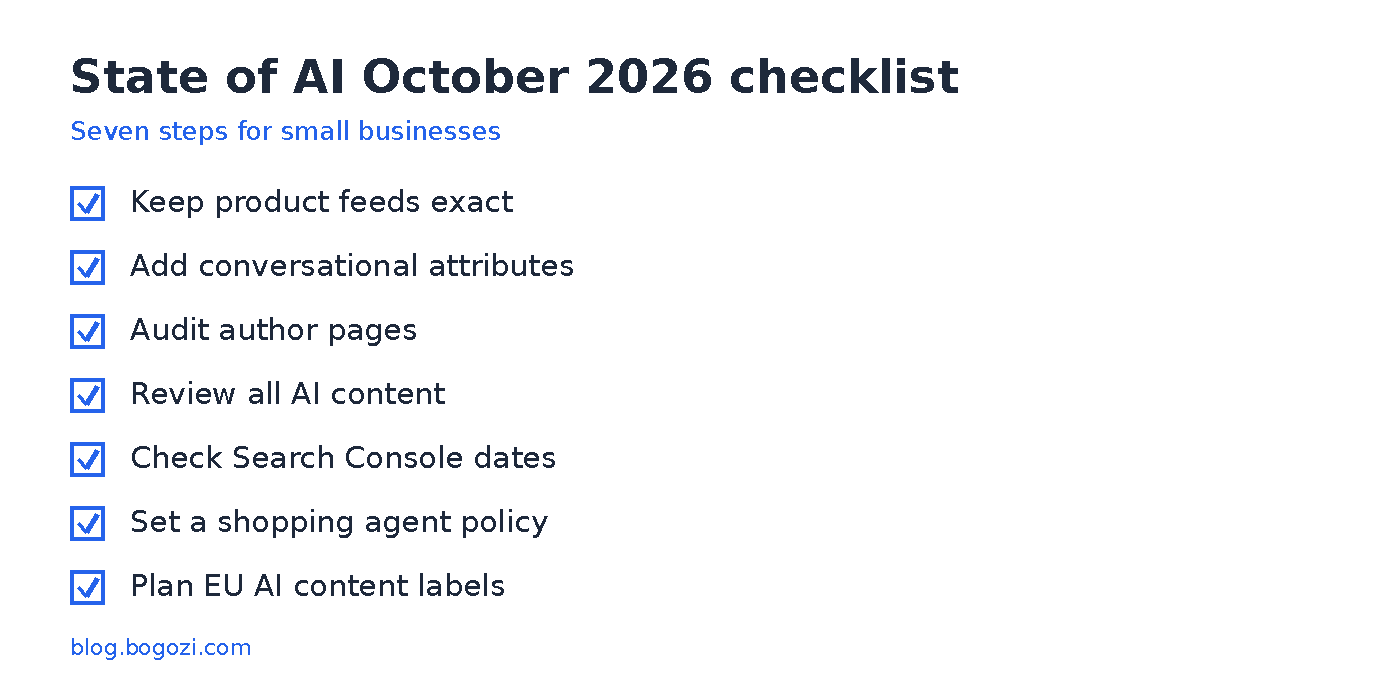
- Keep product feeds exact. Price and stock now trigger AI Mode alerts.
- Add conversational attributes to your products, because AI Mode uses them in recommendations.
- Audit author pages. Remove any AI persona, stock headshot or invented credential.
- Add a human review step for all AI-assisted content, including titles, meta, schema and alt text.
- Compare Search Console data with the 24 September to 8 October spam update dates.
- Decide your policy for shopping agents in robots.txt and at checkout.
- If you publish in the EU, plan how you label AI content under Article 50.
That closes the first state of AI October 2026 edition. Next month I will check which of these trends held up. Meanwhile, read my take on the February 2026 Google update and agentic commerce for the backstory.
Sources
- We’re Not Ready for What’s Coming Next, Aperture (YouTube), 24 July 2026
- Google Rolls Out Monitoring Capabilities In AI Mode To All (quoting Robby Stein, Google), Search Engine Roundtable, 28 September 2026
- Latest Google Search Documentation Updates (entry: Updated guidance on using generative AI content), Google Search Central, 1 October 2026
- Creating Helpful, Reliable, People-First Content, Google Search Central, 1 October 2026
- Google Search Status Dashboard: September 2026 spam update, Google, 24 September to 8 October 2026
- Retailers: Get ready for AI-driven holiday shopping, Google, 16 September 2026
- Reimagining advertising with AI, OpenAI, 16 September 2026
- Introducing Muse: The World’s First Personal AI Agent Built for Everyone, Meta, 8 September 2026
- Introducing GPT-6.1 Sol, OpenAI, 29 September 2026
- Introducing Claude Opus 5.5, Anthropic, 22 September 2026
- Introducing Gemini 4 Argon, Google, 30 September 2026
- Siri AI, a profoundly more capable and personal assistant, is here, Apple Newsroom, 14 September 2026
- Introducing the new Copilot with Home, Code and Autopilot, Microsoft, 25 September 2026
- Introducing Grok 4.7, SpaceXAI (xAI), 21 September 2026
- Sharing AI progress in mathematics, OpenAI, 6 October 2026
- Strong backing for the Code of Practice on Transparency of AI-generated Content, European Commission, 31 July 2026
- Anthropic PBC v. United States Department of War, U.S. Court of Appeals for the D.C. Circuit (via FindLaw), 25 September 2026
- The Future of Jobs Report 2025, World Economic Forum, 2025
- Cat soap operas and babies trapped in space: the ‘AI slop’ taking over YouTube, The Guardian, 11 August 2025
- Experimental evidence of massive-scale emotional contagion through social networks, PNAS, 2014
- Advanced version of Gemini with Deep Think officially achieves gold-medal standard at the International Mathematical Olympiad, Google DeepMind, 2025
- An update from SVP Beth Galetti on Amazon workforce reduction, Amazon, 28 October 2025
- A single DNS race condition brought AWS to its knees, The Register, 23 October 2025
- The GenAI Divide: State of AI in Business 2025, MIT NANDA (report mirror), 2025
- How Can We Meet AI’s Insatiable Demand for Compute Power?, Bain & Company, 2025