
Every few months a client asks me the same thing: is SEO dead now that people ask ChatGPT instead of Google? My answer has not changed. This week, though, I found a neat way to explain it.
Here is the short version. Google still sees far more search-like activity than every standalone AI chat tool combined. So the work is not gone. It has moved, and some of the old metrics now mislead you.
A chart that made the rounds
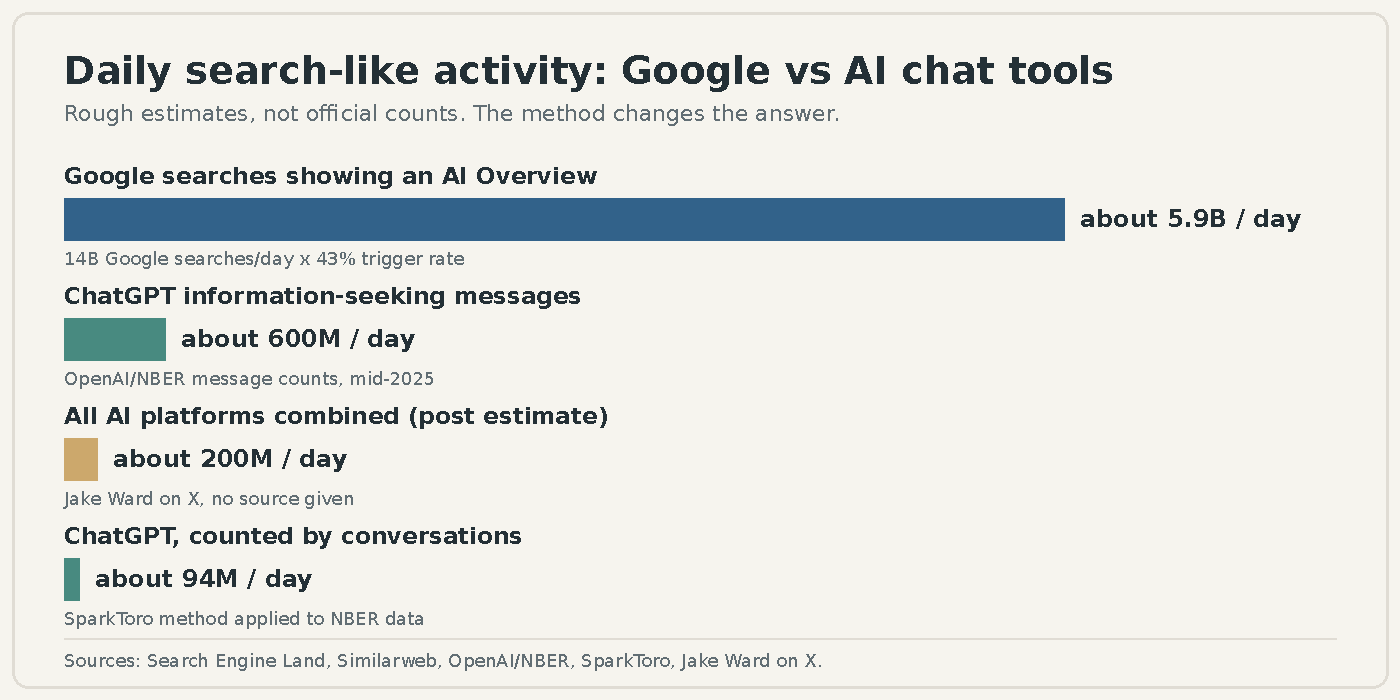
On 5 October 2026, Jake Ward shared a chart on X that compares Google AI with the big AI chat platforms. He puts Google AI at about 5.9B searches a day. ChatGPT, Claude, Perplexity and the rest together get about 200M a day, by his count.
That works out to roughly 30 times more. His takeaway is simple: if you want visibility in AI answers, win Google first. However, the post cites no source, so I checked the numbers before I repeated them to anyone.
What the numbers really say
The 5.9B figure is plausible
Google does not publish a daily count of AI Overview queries. Instead, it shares a yearly total. In March 2025, Search Engine Land reported that Google handles more than 5 trillion searches a year. That comes to roughly 14B searches a day.
Next, you need the share of searches that show an AI Overview. That share swings a lot by source and date. For example, Pew measured 18% of real US searches in March 2025. By mid-2026, Similarweb put it near 43% and Semrush near 48%.
Multiply 14B by 43% and you land near 5.9B. That is my best guess at the origin, because the post does not show its math. With an 18% rate, you would get closer to 2.5B instead.
There is also a catch. An AI Overview on the page does not mean anyone read it. Every query that shows one counts, even when the user scrolls straight past it.
The 200M figure is the weak part
The AI side depends entirely on how you count. The How People Use ChatGPT study from OpenAI and NBER found more than 2.5B ChatGPT messages a day in mid-2025. About 24% of them were people seeking information.
That alone gives around 600M search-like messages a day. It is three times the post’s figure for all platforms together. But count conversations instead of messages, and the picture flips.
SparkToro’s method groups messages into conversations and keeps only the search-like ones. On that basis, ChatGPT lands near 94M a day. Then 200M for all platforms looks believable.
So 200M is not wrong, but it reflects one counting choice among several. The same goes for the 30x ratio. The Google side counts every page with an AI Overview, while the AI side counts filtered sessions. Per message, the gap shrinks to roughly 10x or less.
The direction still holds
Still, independent data points the same way. SparkToro’s March 2026 study looked at US desktop behavior across 41 sites. Google had 73.7% of searches, while all AI tools together had 3.2%.
Rand Fishkin’s verdict was that Google is the largest AI search tool by at least an order of magnitude. In short, Google is roughly 10 to 30 times bigger, depending on how you count. I would not quote 5.9B or 200M as hard facts, though. They remain estimates from one post.
Is SEO dead, or just harder to measure?
Now for the honest counterpoints. A bigger audience does not mean Google sends you the same traffic as before. In fact, the click data tells a rougher story.
Pew Research Center found that users clicked a result on 8% of visits when an AI summary appeared. Without a summary, they clicked on 15%. Only 1% clicked a link inside the summary itself.
Then Ahrefs measured about 58% lower click-through for the top result when an AI Overview shows. That study used December 2025 data.
Zero-click search is not new either. SparkToro’s 2024 zero-click study found that 58.5% of US Google searches ended without a click. That said, the data is not one-sided. When Semrush and Datos tracked keywords before and after an AI Overview appeared, the zero-click rate dipped from 33.75% to 31.53%.
Meanwhile, AI referrals keep growing, but from a small base. Similarweb counted 1.13B AI referrals to the top 1,000 sites in June 2025, up 357% year over year. Google Search sent 191B in the same period. So watch AI traffic, but keep the scale in mind.
The forecast that did not come true
In February 2024, Gartner predicted that traditional search engine volume would drop 25% by 2026. We are now in late 2026, and I found no evidence that it happened.
On the contrary, Google said in its June 2026 investor presentation that queries reached an all-time high in Q1 2026. Then, on its Q2 2026 earnings call, it reported 17% revenue growth in Search and Other. So the volume is still there, even if fewer of those searches end in a click.
What I would actually do now
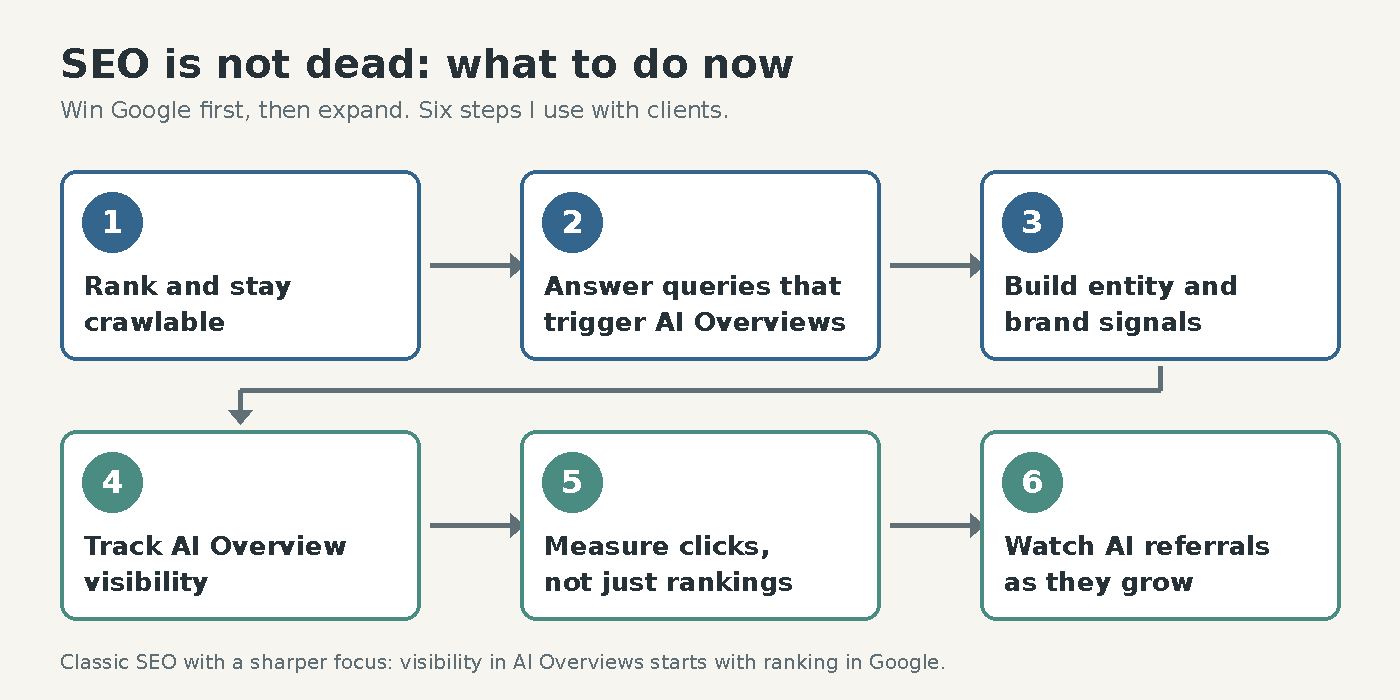
If you came here asking whether SEO is dead, this is the part that matters. Most of it is classic search optimization with a sharper focus.
Rank and stay crawlable
AI answers lean on pages that a search engine can find and read. So technical basics come first. A page can return a 200 status and still hide its content from Googlebot. Also, clear any crawl errors in Search Console before you worry about AI.
Answer the queries that trigger AI Overviews
Find the questions in your niche that already show an AI Overview. Then write the clearest answer on the web for each one. Put the direct answer near the top, and back it up with detail, examples and your own experience.
Build entity and brand signals
Google needs to know who you are and what you do. Keep your name, services and profiles consistent everywhere. Also earn mentions on sites that Google already trusts in your field.
Track AI Overview visibility
Rankings alone no longer show the full picture. Track which of your keywords show an AI Overview, and whether your site appears as a source in it. Do the same for AI Mode when your tools support it.
Measure clicks, not just rankings
A top ranking under an AI Overview can lose more than half its clicks, if the Ahrefs numbers hold for your niche. So report clicks, click-through rate and conversions from Search Console. A stable ranking with falling clicks is a warning, not a win.
Keep an eye on AI referrals
Finally, do not ignore ChatGPT and the others. Their referrals are small, but they grow fast. I check which AI crawlers can reach a site with CrawlerCheck, the bot checker I built, and I segment AI referrals in analytics.
Google keeps changing too, as the February 2026 Google update reminded us. So I review this setup every quarter, not once a year.
The short answer
So, is SEO dead? Not even close. Google still handles the bulk of search-like activity, AI Overviews included. However, the way you win and the way you measure have both changed.
My advice matches the post, with softer numbers: win Google first, then expand. Just do not quote 5.9B versus 200M as fact. Say Google is about an order of magnitude bigger, and the data backs you up.
Sources
- Google now sees more than 5 trillion searches per year, Search Engine Land, 3 March 2025.
- Almost Half Of Google Searches Have AI Overviews & Climbing, Search Engine Roundtable, 30 July 2026.
- How People Use ChatGPT, NBER Working Paper 34255, September 2025.
- New Research: Search Happens Everywhere, SparkToro, 3 March 2026.
- Google users are less likely to click on links when an AI summary appears in the results, Pew Research Center, 22 July 2025.
- Update: AI Overviews Reduce Clicks by 58%, Ahrefs, 4 February 2026.
- Semrush AI Overviews Study, Semrush, 15 December 2025.
- AI referrals to top websites were up 357% year-over-year in June, reaching 1.13B, TechCrunch, 25 July 2025.
- Gartner Predicts Search Engine Volume Will Drop 25% by 2026, Gartner, 19 February 2024.
- 2024 Zero-Click Search Study, SparkToro, July 2024.
- Alphabet investor presentation: June 2026, Google, June 2026.
- Q2 2026 earnings call: Remarks from our CEO, Google, 22 July 2026.
2 comments on “Is SEO dead? Think again”